



Introduction
Drying is one of the oldest and most widely used methods of preserving food and agricultural materials. From mangoes, vegetables and herbs to seafood, meat and certain industrial materials, drying helps remove moisture and can make products easier to store, handle and transport. Yet effective drying involves more than simply applying heat. It is a controlled process shaped by the material itself, the movement of air, temperature, drying time and the required final moisture level.
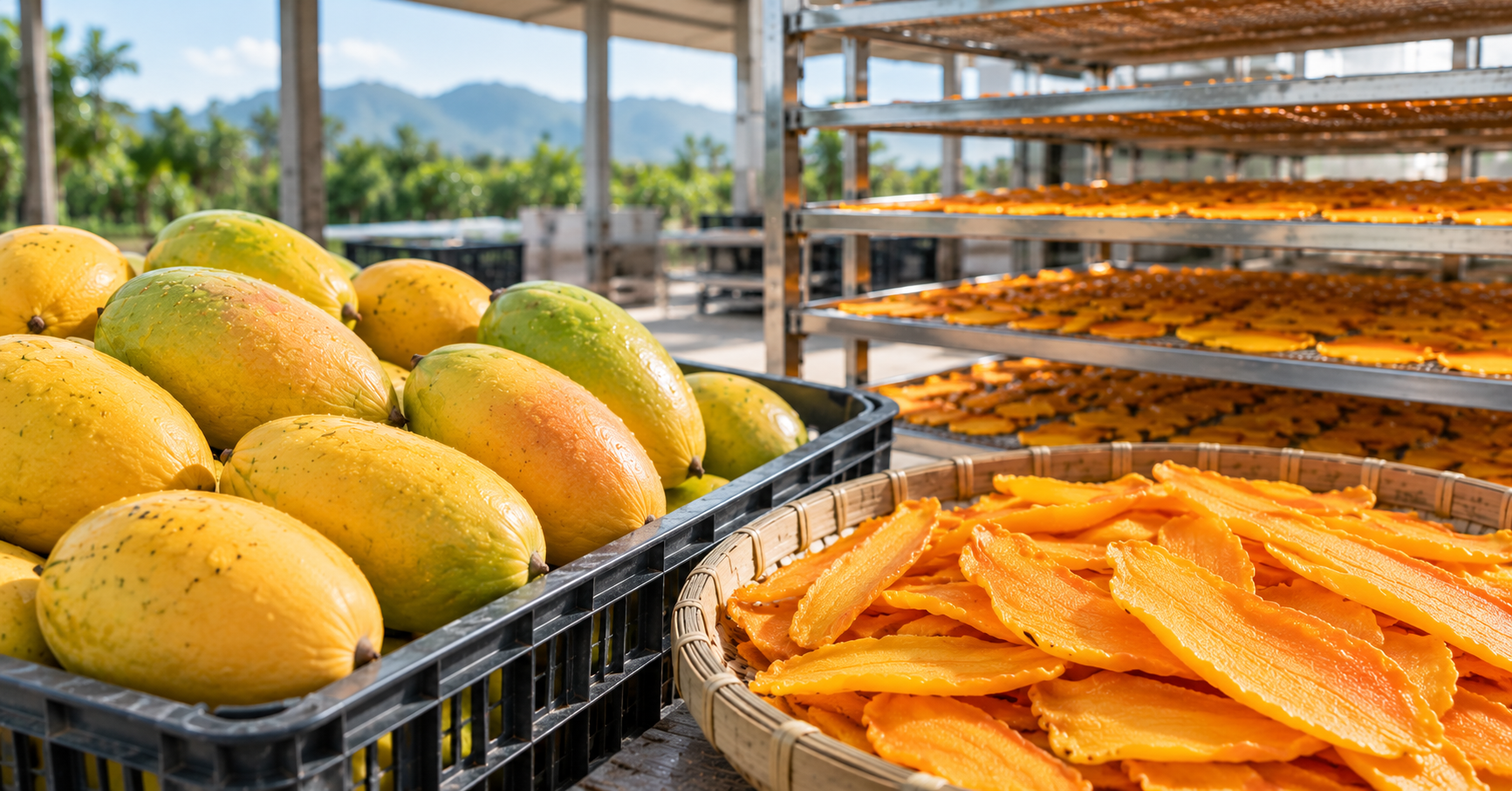
1. What Is Drying?
Drying is the process of removing moisture from a material through heat and mass transfer. In many drying systems, heated air supplies energy to evaporate moisture, while airflow carries the resulting water vapor away from the product. As moisture content decreases, the conditions that allow many microorganisms to grow may become less favorable. However, drying does not automatically sterilize a product, so proper hygiene, suitable processing conditions and appropriate packaging remain important.
2. Why Does Drying Matter?
2.1 Helping Extend Shelf Life
Fresh agricultural products often contain substantial amounts of water and may deteriorate quickly under unsuitable storage conditions. Reducing moisture—and, more importantly for many foods, lowering water activity—can slow the growth of many spoilage microorganisms and help extend storage life. The result depends on the material, the drying method, the final moisture level, packaging and storage conditions.
2.2 Supporting Product Quality
A well-designed drying process aims to reach the desired moisture level while maintaining the product’s useful characteristics. Temperature that is too high or drying that is uneven may affect color, texture, aroma or heat-sensitive nutrients. Choosing appropriate conditions helps balance drying efficiency with product quality; nutrient retention varies by material and process.
2.3 Making Storage and Transportation More Convenient
Removing water can reduce product weight and, in some cases, volume. Dried products may therefore be easier to package, warehouse and transport. For producers and processors, this can improve handling efficiency and help reduce some logistics burdens, depending on the product and packaging format.
2.4 Creating More Flexible Uses and Market Opportunities
Dried ingredients can be used in snacks, seasonings, teas, prepared foods, animal feed and other applications. More stable products can also be easier to distribute over longer distances when they meet the relevant quality, food-safety, packaging and regulatory requirements. Drying is one part of the value chain; it does not by itself guarantee export compliance or market acceptance.
3. Four Key Factors in the Drying Process
3.1 Temperature
Different materials respond differently to heat. A suitable temperature helps drive moisture removal, while excessive heat may cause discoloration, hardening, case formation or damage to heat-sensitive components. The appropriate range depends on the material, its thickness, the equipment and the target quality.
3.2 Airflow
Airflow helps transfer heat to the product and carry moisture away. Air that moves too slowly or unevenly can lead to inconsistent drying, while a well-designed air path helps improve uniformity across trays or batches. Air temperature, humidity, velocity and circulation all influence performance.
3.3 Drying Time and Material Preparation
Drying time is affected by the initial moisture content, slice thickness or particle size, loading depth, air conditions and the material’s structure. Consistent cutting, suitable loading and avoiding overcrowded trays can help make the process more predictable. A fixed time should not be assumed to work for every product or batch.
3.4 Target Moisture Content and Water Activity
The correct endpoint depends on the product’s intended use and storage requirements. Moisture content and water activity are related but different measurements; for many foods, water activity is especially relevant to microbial stability. Where needed, processors should use suitable measuring methods and verify that the dried product meets its specifications.

4. Choosing a Suitable Drying Solution
Before selecting drying equipment, consider the type of material, daily processing capacity, initial and target moisture levels, required product quality, available energy sources, local climate, space and operating costs. Testing representative samples and recording process conditions can help establish a reliable drying recipe. Equipment should be selected around the real material and production requirements rather than temperature alone.
Conclusion
Drying combines practical experience with the science of heat and moisture transfer. When temperature, airflow, time and the final moisture target are properly controlled, drying can help improve storage stability, preserve desired product quality and make handling and distribution more convenient. Understanding the material is the starting point for choosing a suitable process and achieving consistent results.
About Western Flag
Western Flag provides drying equipment and drying solutions for a range of materials and applications. For equipment selection, the required process conditions should be evaluated according to the customer’s material, capacity and final product specifications.
Website: https://www.dryequipmfr.com/

Post time: Apr-05-2026